Go to Market project
Pre-GTM
Step 1: Define the problem & the context
Write the problem statement you’re facing and the goal of the GTM.
Date: August 1, 2025
Brand Context: Groww is India's leading investment platform with approx 14 million active users, democratizing investing for millennials and Gen-Z. The platform offers mutual funds, stocks, ETFs, and other investment products with a focus on simplicity and education.
Problem Statement: A significant portion (65% - guesstimate) of our user base signs up, explores mutual fund options, and even adds funds to watchlists but hesitates to start their first SIP. Despite comprehensive onboarding education, fund research tools, and intuitive UI, first-time investors show analysis paralysis at the commitment stage. This represents a massive opportunity loss in user activation and long-term LTV.
Context: We want to nudge hesitant users into consistent investing behaviour through SIPs, which drives long-term LTV and retention. This GTM focuses on converting high-intent, low-action users (those who've explored funds but haven't started SIPs) into SIP starters through personalised nudges, social proof, gamified incentives, and simplified decision-making frameworks.
Current State Analysis:
- Monthly signups: 8 lakh users
- Fund exploration rate: 75% (6 lakh users)
- SIP start rate: 35% (2.1 lakh users)
- Average first SIP amount: ₹3,200 - well, most Indians start with ₹1000-5000, so ₹3,200 seemed realistic 😅
- Drop-off points: Fund selection (40%), Amount selection (35%), Final commitment (25%)
Step 2: Define the goal
Put the goal in the XYZ framework. The Goal will always be in the format: X metric in Y time with Z constraints. In lean GTMs, the Z is optional.
Acquire 15,000 additional SIPs over the next 30 days, with an average SIP value of ₹4,000, while maintaining user satisfaction scores above 4.2/5 and keeping customer acquisition cost under ₹800 per SIP starter.
X = Specific number (15,000)
Supporting Metrics:
- Increase SIP conversion rate from 35% to 45%
- Improve fund selection completion rate from 60% to 75%
- Reduce time-to-first-SIP from 12 days to 7 days
- Maintain portfolio diversification (average 2.3 funds per user)
Step 3: List down all the input levers to that goal.
List down all input levers required to hit the target.
Bonus: Go deeper by mapping the input levers on a google sheet.
we're trying to get people from "just looking" to "actually investing"
so we want 15,000 people to start SIPs. But how many people do we need to REACH to get 15,000 to actually do it?
Step 1: 15,000 SIP starts ← 75,000 people need to pick a fund to start their SIP. Why 75,000? Because only 1 out of 5 people (20%) who pick a fund actually start the SIP.
Step 2: 75,000 fund selections ← 250,000 people need to engage with our app. Why 250,000? Because only 3 out of 10 people (30%) who engage actually pick a fund.
So How Do We Get 250,000 People to Engage?
We're going to use two main strategies:
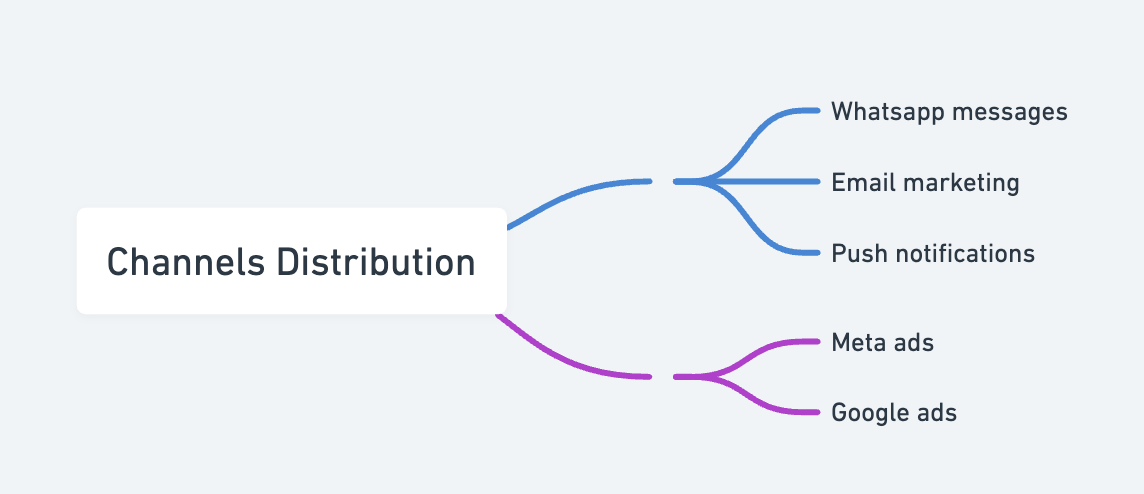
Strategy 1: RETARGETING (70% of our effort = 175,000 people) These are people who already know Groww but haven't invested yet
Strategy 2: PAID ACQUISITION (30% of our effort = 75,000 people)
So we focus MORE effort on people who already know us and LESS effort on finding completely new people
Step 4: The users
Define the ICPs/ users who you will be targeting for this goal
We will be targeting High-Intent, Low-Action Users
Demographics:
- Age: 24-35 years
- Income: ₹6-25 LPA
- Location: Tier 1 & 2 cities (Mumbai, Delhi, Bangalore, Hyderabad, Pune, Chennai etc)
Behavioural characteristics:
- Signed up 7-45 days ago
- Explored 2-3 mutual fund categories
- Completed risk assessment
- Has active bank account linked
- Reads financial content (blog, videos)
- Has not started any SIP yet
Psychological beliefs :
- Investment-curious but decision-anxious
- Values simplicity and expert guidance.
- Prefers mobile-first experiences
- Seeks reassurance before major financial decisions
Exclusions:
- Users who've already started any SIP
- Inactive users (no app usage in 30 days)
- Users with incomplete KYC
- Age <21 or >45 (different messaging strategy needed)
Step 5: User Segmentation
Categorise your users for personalisation of content, offers, products pitches, flow changes etc. This is dependant on the context of your GTM. In the example below, we’ve only demonstrated the thought process. We expect you to scope this out completely and put down the final segmentation and personalisations.
ICP 1 : The intentional and curious researcher (Priyal)
Behaviour:
Spends 15+ minutes per session actively browsing through different mutual funds and comparing options. High intent, but very deliberate, wants to understand everything before making a move. Likely to use the app several times a week but hasn’t started a SIP yet.
What they need:
- - Clear comparative views between funds
- - Value-rich content (risk vs reward breakdowns, SIP growth visuals)
- - Credible nudges from verified investor reviews or social proof
- - Gentle push at decision points
Pitch:
"You've done the research. Now let your money do the work. Start your SIP today with ₹100 only."
ICP 2 – The calculator obsessed (Sunethra)
Behaviour:
Regularly uses SIP calculators and simulations to figure out how much to invest for future goals. These users are driven by numbers, projections, and outcomes.
They may not browse multiple funds but are fixated on outcomes like “How much will I get in 1-3-5 years?”
What they need:
- - Personalised SIP suggestions based on calculator outputs
- - Real examples or testimonials tied to calculator use
- - Nudges that reinforce trust: SEBI registration, performance ratings, low cost
Pitch:
"Your ₹5000 SIP = ₹8.2 Lakhs in 10 years. Ready to start building that future?"
Step 6: Channel and distribution documents
Prepare the documents for the different levers/ teams/ stakeholders.
Step 7: Project planning
Make a project plan nailing the launch date and work the dates backwards. The table should have name of the milestone, owner, description.
Step 8: Cross functional alignment
Write in detail when you will communicate and with whom.
| When | What | Whom |
|---|---|---|
August 1 | Align on campaign objectives, target, ICPs | My immediate manager, CC: PM & Marketing Leads |
August 2 and 3 | Finalise channel distribution and pitch | Performance Marketing teams and marketing leads |
August 5 | Align legal/ops/CS on volume & creatives... | Ops Head, Legal, Customer Support, CC: My PM & Marketing team |
August 7 (Launch Day) | Live monitoring and support sync | All teams |
August 10 | Mid-campaign sync + performance review | Product, Marketing, Data |
August 30 | Wrap-up, insights sharing, next steps | Product + Marketing + Leadership. |
During-GTM
Step 1: Set Milestones
Set milestones for during GTM as a health metric to see if your GTM is on track. Put down the metrics you’ll be tracking.
Week 1:
- 4,000 SIP starts (27% of target of 15000)
- Email open rate > 25%
- Push notification CTR > 8%
- Cost per SIP < ₹600
Week 2 :
- 8,500 SIP starts (57% of target)
- In-app conversion rate >12%
- Fund selection completion >65%
- User satisfaction > 4.0/5
Week 3 :
- 12,500 SIP starts (83% of target)
- WhatsApp engagement >15%
- Average SIP amount >₹3,500
- Retention rate > 80%
Week 4:
- 15,000 SIP starts (100% of target)
- Overall conversion rate >6%
- Customer satisfaction >4.2/5
- CAC < ₹800
Step 2: Analyse & Communicate
Analyse metrics and funnel data with respect to the launch. Apart from this communicate to your stakeholders on the milestones. JTBD is to share the launch and milestones. (Ensure you aren’t communicating with them more than twice)
We will check these things every single day:
- SIP starts vs target
- Channel performance - whats working well (emails, push notifications, whatsapp marketing)
- Cost metrics (Budget)
- Technical issues
Weekly Stakeholder Updates:
when
what
whom
metrics
Aug 7- 14
Week 1 permformace
PM, Marketing team, finance team
4K SIPs, ₹580 CAC, 4.1 satisfaction
Aug 14-21
Week 2 performance
PM, Marketing teeam, finance team
8.5K SIPs, ₹620 CAC, top channels
Aug 21-28
Week 3 performance
PM, Marketing leads
12.5K SIPs, optimization results
Aug 28-31
Final results
Leadership Team
Final numbers vs targets
Note: This last section might not be relevant to you if you just got done with your GTM. But make sure you come back to this and analyse your post GTM success!
If you have done a GTM before, you can use that GTM as a reference to do Post - GTM
Post-GTM
Step 1: User calls
Speak to 5 users to validate the hypothesis your GTM was built on.
We will speak to 15 users across 3 cohorts (5 each)
Cohort 1: Successful converters: Users who started their first SIP during the campaign, successfully tapped ones.
Cohort 2: Engaged non-converters: Users who engaged with campaign (opened emails, clicked notifications) but didn't start the first SIP.
Cohort 3: Campaign non-responders: Users who were targeted but showed minimal engagement.
Step 2: Look at data
Collate all data and analyse to validate your hypothesis
We will look at a lot of success metrics and data:
Email open rate
Campaign CTR
App logins
Session time on App
# users using the SIP calculator
#users starting the first SIP successfully
cost per sip
best performing campaign
Step 3: Debrief
Write a small debrief doc. Share this with the main stakeholders and hold a 15 min debrief with the end stakeholders.
In the debrief document, we will measure:
> If campaign objectives are achieved
> Impact on revenue
> GTM effficiency
> what worked wht didn't.
> key learnings and insights.
Brand focused courses
Great brands aren't built on clicks. They're built on trust. Craft narratives that resonate, campaigns that stand out, and brands that last.


All courses
Master every lever of growth — from acquisition to retention, data to events. Pick a course, go deep, and apply it to your business right away.





Courses
Built by Leaders From Amazon, CRED, Zepto, Hindustan Unilever, Flipkart, paytm & more








Crack a new job or a promotion with ELEVATE
Designed for mid-senior & leadership roles across growth, product, marketing, strategy & business




Learning Resources
Browse 500+ case studies, articles & resources the learning resources that you won't find on the internet.

Patience—you’re about to be impressed.